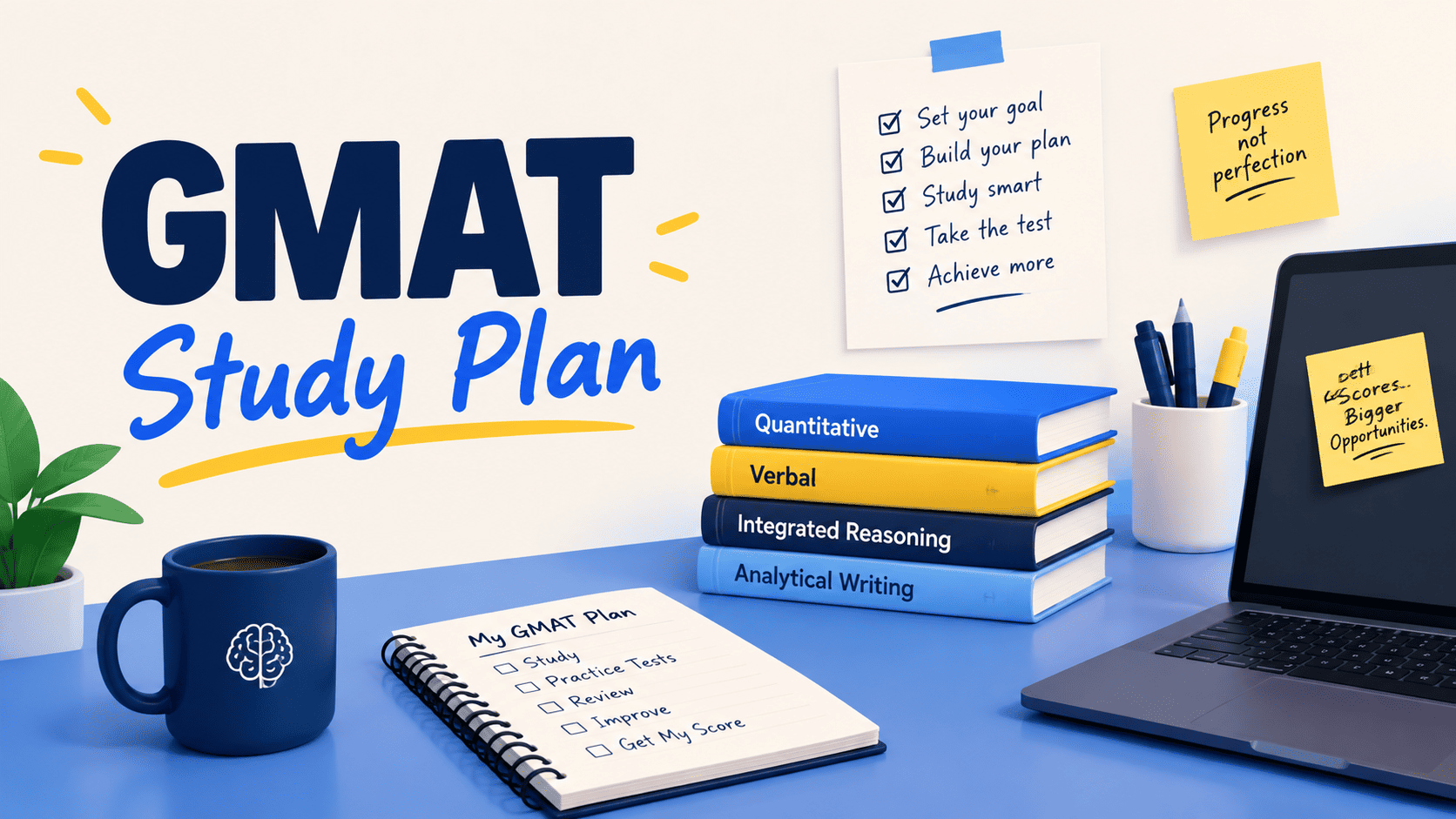
Four people in my extended circle sat the GMAT inside an eighteen month window. All four gave themselves roughly sixty days. All four bought the same official guide and downloaded a similar looking spreadsheet off Reddit.
Three of them plateaued and one of them moved her score by more than a hundred points on the old scale.
The difference wasn't intelligence, and it wasn't hours. Two of the three who stalled put in more total time than she did. The difference was that she treated every wrong answer as the actual unit of work, and they treated question count as the unit of work. That single swap is most of this article.
I should be straight with you about my position here. I'm not an MBA candidate. I've spent ten years writing software, I run a learning company in Lagos, and I got pulled into this because two of the four asked me to help rebuild their study schedule after it fell apart. What I know about the GMAT I know from taking the diagnostic myself to understand the format, sitting with their error logs, and reading the learning science literature that their study plans were quietly violating. Take the test-taking tactics from people who scored. Take the schedule architecture from me.
First, know what you're actually sitting
A lot of advice floating around online is still describing a test that no longer exists. The GMAT Focus Edition replaced the classic format, and if your plan is built around the old one you'll waste weeks.
What you're sitting now: three sections, forty five minutes each, two hours fifteen minutes total, sixty four questions. Quantitative Reasoning, Verbal Reasoning, Data Insights. Total score runs 205 to 805 in ten point increments. You choose the order of the sections. You can bookmark questions and change up to three answers per section at the end, which is a bigger deal than it sounds and I'll come back to it.
What's gone: the essay, Sentence Correction, and geometry. Data Sufficiency moved out of Quant and into Data Insights, where it now sits alongside table analysis, graphics interpretation, multi-source reasoning and two part analysis.
Two implications. First, if you're a non native English speaker who was planning to grind grammar rules, stop. Sentence Correction is not on the test. Verbal is Reading Comprehension and Critical Reasoning only. Second, Data Insights is a full third of your score and it is the section almost everyone under-prepares, because the prep material for it is thinner and less familiar. That's an arbitrage opportunity, and I'll come back to that too.
The test is also section adaptive in the sense that question difficulty adjusts as you go. You cannot skip forward and come back freely the way you can on a paper test. Pacing is a scored skill, not an administrative detail.
The failure mode: question count as the metric
Here's what killed three of the four plans.
The spreadsheet says thirty questions a day. You do thirty questions a day. You get maybe sixty percent right. You glance at the explanations for the ones you missed, nod, think "oh right, I should have seen that," and move to tomorrow's thirty. Six weeks later you're still at sixty percent and you've done thirteen hundred questions.
The nodding is the problem. "I should have seen that" is a feeling, not a repair. It's what Robert Bjork's group at UCLA calls an illusion of competence, the gap between how well you feel you're performing during study and how much you've actually retained. Reading a clear explanation produces fluency. Fluency feels like understanding. It isn't.
Bjork's broader finding, built over forty years, is that the conditions which make study feel harder often produce better long term retention. He calls them desirable difficulties. Retrieving an answer from memory beats re-reading it. Spacing practice out beats massing it. Mixing problem types beats blocking them. Every one of those is less pleasant in the moment and better on test day.
The most robust result in this whole literature is the testing effect. Roediger and Karpicke's 2006 studies showed that students who spent study time retrieving material dramatically outperformed students who spent the same time re-reading it, with the gap widening as the delay before the final test grew. Dunlosky and colleagues ran a big 2013 review of ten study techniques and rated exactly two as high utility: practice testing and distributed practice. Highlighting and re-reading, the two things most people default to, came out at the bottom.
The GMAT is almost perfectly designed for this. Practice questions are retrieval practice. You're already doing the high utility thing. The failure is in what happens in the ninety seconds after you see the red X.
What she actually did: the error log
The one who scored kept an error log, and hers was not the typical three column thing people abandon by day nine.
Every wrong answer, and every right answer she wasn't confident about, got one row. Six fields:
Date. So she could space the re-attempt.
Question source and number. So she could find it again without hunting.
The specific reason it went wrong, in her own words, in a full sentence. Not "Data Sufficiency." Not "careless." Something like "I assumed x was an integer because the question used the word 'items' and nothing said integer." This field is the whole point. If you can't write a sentence, you haven't diagnosed anything yet.
Category tag, chosen from a short fixed list she wrote in week one and never expanded past about twelve entries. Content gap, misread the question stem, arithmetic slip, wrong approach chosen, ran out of time, fell for the trap answer, and so on.
The correct approach in one line, written from memory after closing the explanation. Not copy-pasted. She read the explanation, closed it, waited, then wrote what she'd do next time. This is retrieval practice applied to the repair itself, and it's the step almost nobody does.
Re-attempt dates. Two of them. Roughly three days later and roughly two weeks later.
Then every Sunday she sorted by category tag and counted. The count told her what the coming week was for. That's it. That's the machine. Not motivation, not a colour coded calendar, just a weekly count of her own failure modes driving what she studied next.
The categories matter more than people expect, because the repairs are completely different. A content gap means you don't know a rule and you need to learn it. A misread stem means your reading process under time pressure is broken and no amount of content review will fix it. A trap answer means you're pattern matching instead of reasoning. Three totally different problems, and the generic advice "do more practice questions" only addresses the first one.
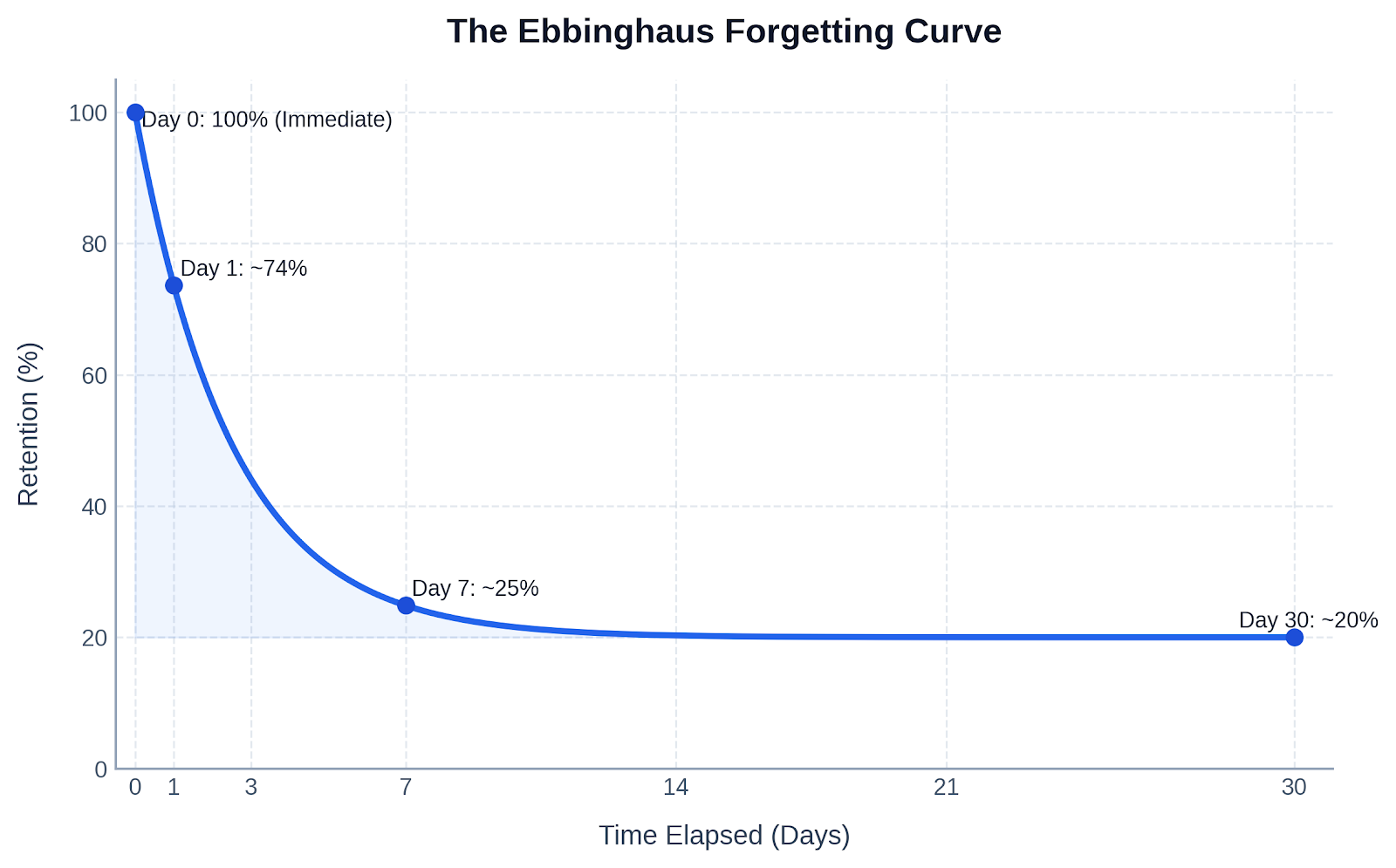
The spacing on the re-attempts isn't arbitrary either. Cepeda and colleagues' 2006 meta analysis across hundreds of experiments found distributed practice reliably beat massed practice, and their 2008 follow up found the optimal gap scales with how long you need to hold the material. For a test sixty days out, gaps measured in days to a couple of weeks are roughly the right shape. Re-attempting a missed question the same evening tells you nothing, because you still remember the explanation.
Her ratio, over the full sixty days, was close to one hour of logging and review for every hour of new questions. Fifty fifty. The three who stalled were running something closer to ninety ten.
The sixty day skeleton
Here's the schedule I'd build, adapted from what worked for her and corrected for what went wrong for the others. Assume you're working full time, so roughly two hours on weekdays and four to five on one weekend day. That's about ninety to a hundred hours total, which is in the normal range for a meaningful score improvement.
Days 1 to 3: diagnostic and honest triage. Sit a full length official practice test under real conditions. Real timing, no pausing, no phone, at roughly the time of day your real test is booked for. The score matters less than the section breakdown and the error pattern. Then build your category list from that one test. Do not start content review before you have this. Three of the four skipped or half-did this step and spent their first two weeks studying things they were already fine at.
Days 4 to 20: content repair, blocked. This is the only phase where blocked practice, meaning all one topic at a time, is the right call. You're closing content gaps and you need concentrated exposure. Sweller's cognitive load work is the argument here: when material is genuinely new, stripping away extra demands lets you build the underlying pattern. Interleaving too early just means failing at everything simultaneously. Untimed or generously timed. Error log running from day four.
Days 21 to 40: interleaved and timed. Now switch. Mixed question types, mixed difficulty, strict per question timing. This is where most of the score moves. The reason to interleave is that the real test doesn't tell you which topic a question is from, and identifying the type is itself a skill you can only practise under mixed conditions. Rohrer and Taylor's work on interleaved maths practice found exactly this pattern: interleaved groups look worse during practice and considerably better on delayed tests. Expect your accuracy to dip in week four. It's supposed to.
Days 41 to 54: full mocks and pattern hunting. One full length mock per week, minimum three total, under real conditions. Each mock gets a full day of review afterwards. Not an hour. A day. The mock is a diagnostic instrument, and taking a mock you don't fully review is just an exhausting way to feel bad.
Days 55 to 60: taper. Volume drops by half. No new content. You re-read your error log, re-attempt your flagged questions, and sleep. This part is not soft advice. Consolidation during sleep is one of the better established findings in memory research, and the person who crams through the night before a two hour fifteen minute adaptive test is sabotaging the only cognitive resource that matters on the day.
Pacing, and the thing everyone gets wrong about guessing
Forty five minutes for twenty one Quant questions is about two minutes and ten seconds each. Verbal is twenty three questions in forty five, so a bit under two minutes, though Reading Comprehension passages break that average badly. Data Insights is twenty in forty five, and some of those are multi part.
The rule that rescued her timing: a hard stop at three minutes, no exceptions. If you're not on a clear path to the answer at three minutes, pick the best remaining option, bookmark it, move on. She practised this with a timer visible from day twenty one, and she practised it badly at first, which is the point of practising it.
The instinct to fight a hard question to the death is the single most expensive habit on an adaptive test, because the cost isn't the one question. It's the four rushed questions afterward. Two of the three who stalled had this exact problem, visible in their mock data as a collapse in accuracy in the last third of every section.
The bookmark and edit feature is your safety valve. Three changes per section. Use them on the ones you bookmarked at the three minute stop, not on second-guessing answers you were confident about. Confident answers changed under time pressure are usually changed wrong.
One more pacing note. Pick your section order deliberately and practise in that order for the last month. There's no universally correct sequence. There is a correct sequence for you, and it's usually strongest section first if you need the confidence, or weakest first if you fade late. Decide it by week five and stop changing it.
Data Insights is where the cheap points are
If you're short on time, this is my highest leverage piece of advice. Most people allocate their prep roughly by fear: Quant if they're humanities, Verbal if they're an engineer. Almost nobody allocates by return on effort.
Data Insights is a full third of the score, the question formats are unfamiliar to nearly everyone, and the prep ecosystem for it is thinner than for Quant and Verbal. That combination means the marginal hour spent there usually returns more than the marginal hour spent on your fortieth algebra drill. Table analysis and graphics interpretation in particular are mostly about reading carefully and not doing arithmetic you don't need to do, which is trainable in days rather than weeks.
Multi-source reasoning is the exception. It's slow, it's genuinely hard, and it rewards a specific habit: read the tabs before you read the question, build a rough mental map of what lives where, then answer. People who dive straight to the question end up reading all three tabs anyway, in a worse order.
Verbal, briefly, for the engineers
Critical Reasoning is the most trainable thing on the test and I say that as someone whose day job is essentially debugging arguments. Every CR question is a small system with a conclusion, evidence, and an unstated assumption connecting them. Find the gap and most answer choices eliminate themselves. If you write code, you already have the reasoning apparatus. You just need the vocabulary of question types: strengthen, weaken, assumption, inference, flaw, paradox.
Reading Comprehension improves slowly and mostly through reading dense unfamiliar prose regularly, not through technique. If your RC is weak with sixty days left, the honest move is to defend it rather than try to transform it. Learn to map paragraph function rather than absorb detail, accept that you'll take longer on the first passage read, and spend the hours you'd have burned here on Data Insights instead.
Doing this with a job
All four of these people had full time jobs. So do you, probably.
Two hours on a weekday is not two hours of good work if it's two hours after a nine hour day and a commute. What actually held up was ninety minutes in the morning before work and thirty minutes of error log review in the evening. The morning block does new and hard material. The evening block does retrieval on old material, which is lower energy and, per the spacing research, exactly where it belongs.
I'll add the Lagos caveat because it's real and most study plans written elsewhere ignore it: if your power is unreliable, your study plan needs an offline mode. Download the question sets. Keep a physical notebook for the error log, or at least a local copy. The number of study sessions I've personally lost to an outage plus a cloud-only app is not small. Build the plan that survives your actual conditions, not the plan that assumes a quiet room and a stable grid.
Missing a day is not the failure mode. Missing a day and then abandoning the schedule is. The plan above has enough slack that you can lose four or five sessions across sixty days and still arrive intact.
What to cut
Anything that isn't retrieval or repair.
Cut re-reading chapters. Cut highlighting entirely, and if you want the full argument for why, I wrote it up separately. Cut video lectures beyond the minimum needed to close a specific identified content gap, because watching someone else solve a problem is recognition, not production. Cut the third forum thread about whether some question is representative. Cut buying more material. Nobody in the history of this test has failed to improve because they ran out of practice questions.
And cut the target score obsession. She checked her mock scores three times in sixty days. The other three checked constantly, and score anxiety ate study time that should have gone into the log.
The part that's hard to hold together by hand
Everything above is one system with a lot of moving parts. A content gap you close in week two has to still be closed in week nine. Your category counts have to drive next week's schedule. Your flagged questions have to come back at the right intervals, not whenever you happen to remember them. The person who scored ran all of that manually, in a notebook and a spreadsheet, every Sunday for sixty days. It worked, and it was a second job.
That admin is roughly why I built Edirae. It's a full learning platform rather than a flashcard add-on: you give it source material, it builds the study path, it adapts as your weak areas show up, and the spaced repetition runs underneath so nothing you've already repaired quietly decays while you're busy elsewhere. For a sixty day run that means your error log categories decide what resurfaces and when, without you maintaining the schedule yourself. You can absolutely do this by hand, and a notebook plus Anki gets you most of the way. Edirae just takes the upkeep off you. Three day free Pro trial at edirae.com if you want to point it at one week of your log and see.
FAQ
Is 60 days enough for the GMAT?
For most people with a working quantitative base and a full time job, yes, for a meaningful improvement. Ninety to a hundred focused hours fits comfortably inside sixty days. What sixty days can't reliably do is repair a fundamental arithmetic or algebra gap and build test technique at the same time. If your diagnostic shows you struggling with core secondary school maths, budget ninety days or more.
How many practice questions should I do per day?
Fewer than you think. Twenty well reviewed questions beat sixty skimmed ones. Target roughly a one to one split between time spent answering and time spent logging and repairing. If you're doing more than about thirty a day, you almost certainly aren't reviewing them properly.
How many full length mock tests should I take?
Three to five across the sixty days, with a full review session after each. More than five usually means you're substituting mocks for targeted repair, which feels productive and isn't. Sit at least two of them at the same time of day as your real appointment.
Should I take Quant, Verbal or Data Insights first on test day?
There's no universally right order. Decide based on your mock data, usually strongest section first if nerves are your problem or weakest first if your accuracy fades late, then lock it in by week five and practise in that order.
Do I still need to study Sentence Correction and geometry?
No. Neither appears on the GMAT Focus Edition. If a study guide is drilling you on idioms and circle theorems, it predates the current format and you should replace it.
Is the GMAT a maths test?
Not really. Quant is arithmetic, algebra and word problems wrapped in reasoning traps. The maths content stops well below university level. What's being tested is whether you can read precisely under time pressure and avoid unwarranted assumptions, which is why the error log catches so many "careless" mistakes that turn out to be systematic.
What should I do the week before?
Halve your volume, stop all new content, re-attempt your flagged error log questions, and protect your sleep aggressively. Sleep does the consolidation work. Cramming the night before a two hour fifteen minute adaptive reasoning test trades your sharpest resource for a marginal amount of material you probably won't recall anyway.
What if my mock scores stop improving?
Sort your error log by category and look at what actually dominates. Plateaus are almost always one or two failure modes repeating, and they're usually process failures rather than content gaps: pacing collapse in the final third, or misreading question stems. Both need a process fix, not more questions.
Related Articles
How to Introduce Yourself in an Interview (The 90-Second Formula That Actually Works)
The first 90 seconds of a job interview decide more than most candidates realize. Research from the University of Toledo showed that interviewers form a "hire or don't hire" judgment within the first 3-5 minutes of an interview. Everything after that is confirmation bias. Your qualifications, your project stories, your questions at the end, they all get filtered through the impression you made at the start.

How to Train Your Brain to Do Hard Things
The Neuroscience, The Protocol, and Why Most People Give Up on Themselves in Week 3
The Complete Guide to Spaced Repetition
The most comprehensive guide to spaced repetition. Learn the science behind why it works, how to use it, and the tools that make it easy. Written by learning practitioners, not marketers.