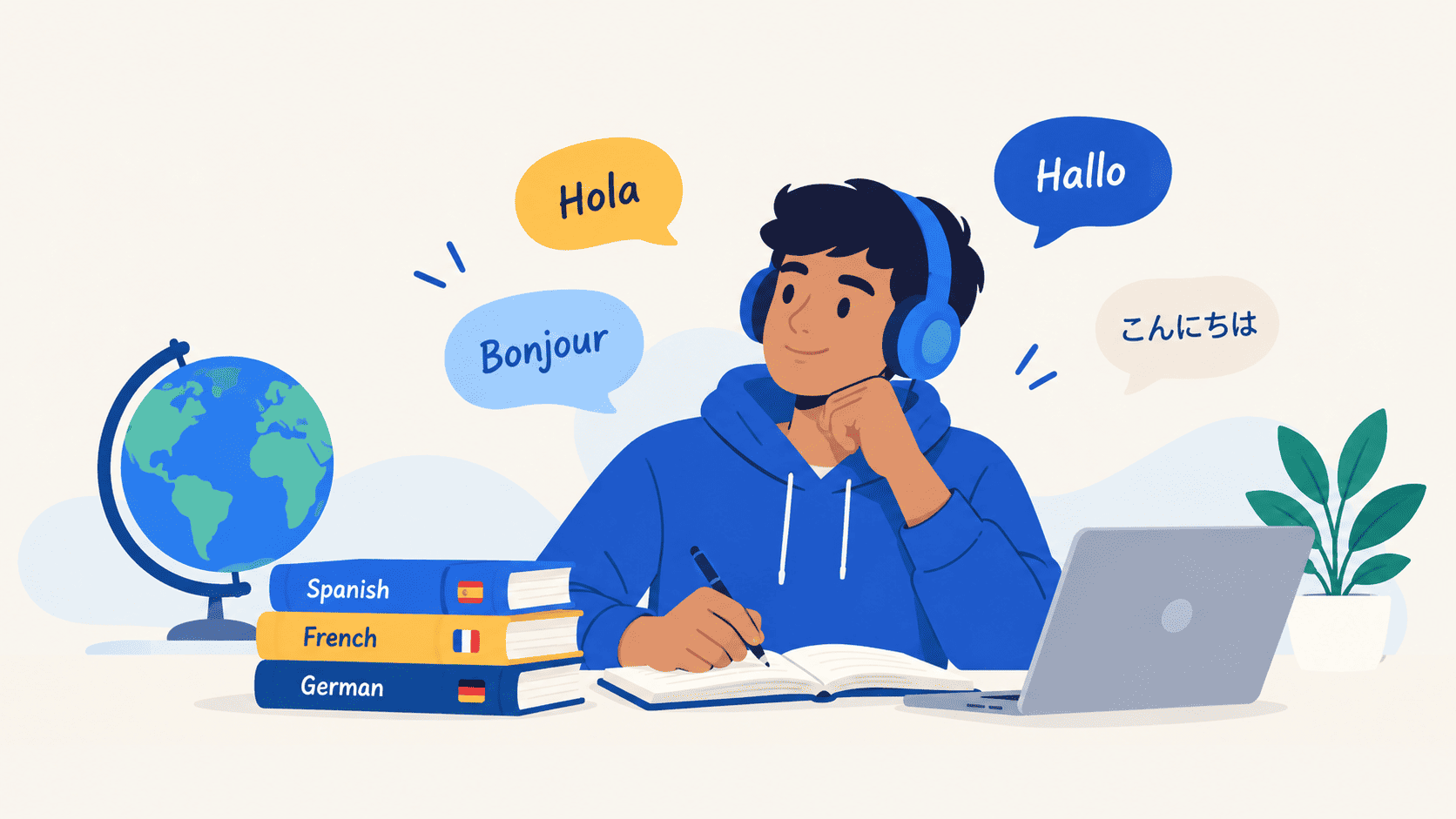
THE PROBLEM
I'm on day 14 of learning Mandarin. Mandarin is the third language I've tried to seriously study. The first two attempts failed.
Attempt 1: French, six years ago. Duolingo streak of 87 days. I could order coffee. I could not hold a real conversation. I quit.
Attempt 2: Spanish, three years ago. Bought a Rosetta Stone subscription. Did 20 minutes a day for two months. Could name colors. Could not understand a native speaker at normal speed. I quit.
I'm still trying Mandarin. This time it might work. Here's why: I finally learned how to study a language the way linguists actually recommend, not the way apps make me feel productive.
Most people who "try to learn a language" are running one of the failed patterns I ran. They stick with one app. They over-practice one skill (usually vocabulary). They never encounter native speech. They plateau at A2, get discouraged, and quit.
This article is the full method. Five phases. Specific tools per phase. A daily protocol you can actually maintain.
If you follow it, you will reach conversational fluency (B1-B2 level) in 12-18 months of consistent 30-minute daily practice. Not "fluent in 3 months." That's marketing. Real fluency takes longer than any app promises. But it's absolutely reachable if your method is right.
WHY MOST LANGUAGE LEARNING FAILS
Before the method, understand the diagnosis. Language learning fails for four specific reasons.
Reason 1: Learners practice only one skill.
There are four language skills: reading, writing, listening, speaking. Most apps train one (usually reading + light listening). Learners who use only Duolingo can read basic sentences and cannot speak. Learners who use only Pimsleur can speak basic phrases and cannot read. Fluency requires all four, practiced separately and combined.
Reason 2: No systematic vocabulary retention.
The average adult needs 3,000-5,000 words to reach conversational fluency. Without a retention system, you learn 200, forget 150, learn 200 more, forget 150 more, and never accumulate. Spaced repetition solves this. Nothing else does at scale.
Reason 3: No exposure to real native speech.
App audio is clean, slow, and enunciated. Real native speech is fast, slurred, and full of contractions. Learners who never listen to real speech get destroyed the first time they meet a native speaker. This is the single biggest cause of the "I've studied for a year and can't understand anyone" phenomenon.
Reason 4: No speaking practice until it's too late.
Speaking is the most uncomfortable skill and the most neglected. Most learners avoid it for months, then panic when they need to speak. Speaking must start in week 1, even at the risk of being awful.
The method below solves all four.
THE 5-PHASE FRAMEWORK
Every strong language learner goes through the same 5 phases, whether they realize it or not.
Phase 1: Foundation (weeks 1-4)
Goal: Learn the sounds, alphabet or script, and 100-200 highest-frequency words.
What to actually do:
- Learn the phonetic system first. Pronunciation is the hardest to fix later.
- Learn the alphabet/script (if new, like Mandarin characters, Arabic script, Cyrillic).
- Memorize the 100 highest-frequency words (they cover ~50% of conversational speech).
- Do simple listening exercises daily so your ear starts adjusting. Tools:
- Duolingo (basic vocabulary + habit)
- Pimsleur or Language Transfer (audio pronunciation)
- Anki or Edirae for the top 100 words with spaced repetition Time investment: 30 minutes daily. Cannot skip.
Phase 2: Vocabulary building (months 2-4)
Goal: Grow from 200 words to 1,500 words. Learn basic grammar patterns.
What to actually do:
- Aggressive vocabulary expansion, 15-20 new words per day
- Every new word goes into a spaced repetition system with an example sentence
- Learn grammar patterns as needed to use the vocabulary (not grammar for its own sake)
- Start reading beginner-level content daily (graded readers, children's books, LingQ) Tools:
- Spaced repetition (Anki, Edirae) for vocabulary + grammar patterns
- Graded readers (LingQ, Beelinguapp)
- Youtube channels for beginners in the target language Time investment: 30-45 minutes daily. This is the grind phase.
Phase 3: Grammar consolidation (months 4-6)
Goal: Get comfortable with the language's main structures. Move from words to sentences.
What to actually do:
- Systematic grammar review with a real textbook (not app grammar)
- Write short paragraphs daily, get corrections from a native speaker (iTalki, Discord communities, HelloTalk)
- Continue vocabulary via spaced repetition
- Watch beginner-level YouTube content in the language with subtitles in the language (not English) Tools:
- A real grammar textbook (varies by language)
- HelloTalk or iTalki tutors for corrections
- Continue Anki/Edirae for vocabulary + new grammar Time investment: 30-45 minutes daily.
Phase 4: Comprehensible input immersion (months 6-12)
Goal: Shift from studying the language to consuming the language. This is where fluency actually grows.
What to actually do:
- Watch native content with target-language subtitles (podcasts, YouTube, TV)
- Read native content (news articles, novels, short stories)
- Listen to native podcasts during walks/commutes
- Continue speaking practice with AI (Speak) or human tutors (iTalki)
- Reduce spaced repetition to maintenance mode (10-15 min/day) The linguistics term for this phase is "comprehensible input" (Krashen 1985). The idea: you learn a language most efficiently by being exposed to content slightly above your current level. Not so hard you understand nothing. Not so easy you learn nothing.
Tools:
- Netflix + Language Reactor extension
- Podcasts in target language (find any at your level)
- Speak for AI conversation practice
- iTalki for weekly human tutoring Time investment: 45-60 minutes daily (most of it is passive listening while doing other things).
Phase 5: Active production + refinement (months 12+)
Goal: Move from consumer to producer. Speak, write, think in the language.
What to actually do:
- Speak with native tutors 2-3x per week for 30-45 minutes
- Write essays or journal entries in the language, get corrected
- Consume native content without translation aids
- Actively use the language in real contexts (travel, online communities, native-speaker friends) Time investment: 45-60 minutes daily, most of it real use rather than "studying."
THE 30-MINUTE DAILY PROTOCOL (works for any phase)
If you have 30 minutes a day, this is how to split it.
Minutes 0-10: Spaced repetition (retention) Review whatever vocabulary and grammar patterns are due today. Use Anki or Edirae. This is the non-negotiable part. Skip this and everything else compounds slower.
Minutes 10-20: New material or active practice Depending on your phase:
- Foundation/Vocabulary: learn 10-15 new words with example sentences
- Grammar: work through one grammar concept with a textbook or video
- Immersion: watch or read 10 minutes of native content, look up 5 unknown words Minutes 20-30: Output practice This is what most learners skip. Speak or write in the target language.
- Speaking: use Speak, or record yourself answering a question and listen back
- Writing: write 5-10 sentences about your day and get them corrected on HelloTalk 30 minutes daily. Every day. For 12-18 months. That's the actual path.
Doubling to 60 minutes doesn't halve the timeline (learning has diminishing returns per-day). Consistency beats intensity. 30 minutes for 365 days > 90 minutes for 100 days.
USING EDIRAE FOR LANGUAGE LEARNING (WORKED EXAMPLE)
I'm using Edirae for the Mandarin quest specifically as the retention layer. Here's how it fits into the daily 30 minutes.
Setup (one-time, 15 minutes):
- Created a Mandarin project in Edirae
- Fed it my source material: the HSK 1 word list (300 words) + 30 grammar patterns from my textbook
- Edirae automatically generated flashcards for each word (character → pinyin → English + example sentence) and each grammar pattern (structure → example → English translation) Daily use (10 min):
- Open Edirae. Review whatever's due today (usually 30-50 cards).
- Each card asks me to recall in different directions: character to English, English to character, character to pinyin, pronounce the sentence aloud.
- Rate my confidence 1-5 after each card. The confidence rating tells the system what to prioritize. Weekly (5 min):
- Add 15-20 new words I encountered during immersion (podcasts, YouTube). Paste them into Edirae. It generates the card and adds to the schedule. Why this works better than doing it manually in Anki:
- I don't spend 30 minutes per day making cards. Edirae generates them from source material.
- The retention curve adapts to me personally. Words I struggle with come back more often. Words I know cold get pushed to longer intervals.
- Grammar patterns get spaced along with vocabulary, so I'm not just memorizing words in isolation. What Edirae does NOT do:
- Teach me speaking (Speak does that)
- Give me native input (podcasts and Netflix do that)
- Provide grammar explanations (my textbook does that) The mistake most learners make is trying to use one tool for everything. Edirae is one layer of a stack. Speak is another. Immersion content is a third. A weekly human tutor is a fourth. Together, they cover all four skills.
If you want to try this stack, Edirae has a 3-day free Pro trial at edirae.com. Paste any language source (a word list, a grammar guide, a paragraph from a book) and it generates the retention layer for you.
THE 6 MOST COMMON MISTAKES
Mistake 1: Using only Duolingo. Duolingo is a great on-ramp. It's not sufficient. If you're 6 months in and still only using Duolingo, you have hit the ceiling. Add spaced repetition + native content + speaking practice.
Mistake 2: Learning grammar before you can say anything. Traditional textbooks front-load grammar. Skip that. Learn phrases and vocabulary first. Grammar makes sense in context, not in isolation.
Mistake 3: Avoiding speaking practice until you feel "ready." You will never feel ready. Start speaking in week 1. Use Speak, an AI tutor, or record yourself. Speaking is a muscle. It only grows with use.
Mistake 4: Consuming content that's too hard. If you're B1 and trying to read literature, you'll look up every third word and quit. Content needs to be slightly above your level. If you're understanding 80-90% of what you consume, you're in the right zone. Below 60% understanding, drop down a level.
Mistake 5: Not using spaced repetition for vocabulary. Vocabulary retention is the single biggest predictor of fluency progress. Learners without a spaced repetition system forget faster than they learn. Learners with one accumulate. Do not skip this layer.
Mistake 6: Setting unrealistic timelines. "Fluent in 3 months" is marketing. Realistic timelines:
- A1 (basic phrases): 2-3 months
- A2 (survival tourist): 6 months
- B1 (basic conversation): 12 months
- B2 (comfortable conversation): 18-24 months
- C1 (professional fluency): 3-5 years
- C2 (near-native): 5-10+ years Set your expectations here. Learners who set them at "3 months to fluent" quit in month 4. Learners who set them at "12-18 months to B1" get there.
THE REALISTIC 12-MONTH ROADMAP
Here's what a 12-month path to B1 looks like for someone doing 30 minutes daily.
Month 1: Foundation
- Learn phonetics + alphabet
- 100 highest-frequency words
- Basic greetings and self-introduction
- Milestone: introduce yourself in 5 sentences Month 2-3: Early vocabulary
- 300-600 words accumulated
- 5-10 basic grammar structures
- Start listening to slow content daily
- Milestone: understand slow YouTube content aimed at learners Month 4-6: Middle grind
- 1,000-1,500 words accumulated
- Comfortable with present, past, future tenses
- Reading short articles with dictionary help
- First real conversations with a tutor (halting, but functional)
- Milestone: 5-minute conversation with a patient native speaker Month 7-9: Immersion shift
- 2,000-3,000 words
- Watch native content with target-language subtitles
- Regular tutor sessions
- Read novels in the language (with help)
- Milestone: understand 60-70% of a slow podcast Month 10-12: Consolidation
- 3,000-4,000 words
- Comfortable in real conversations
- Consume some content without translation aids
- Write short essays that get corrected
- Milestone: hold a 20-minute conversation without switching to English At month 12 you're a B1. Not fluent yet. But you're now a language learner who can compound. From here, another 12-24 months of consistent input gets you to B2 (comfortable fluency).
FREQUENTLY ASKED QUESTIONS
What is the best way to study a new language?
The most effective method combines four skills: reading, listening, speaking, and writing. It uses spaced repetition for vocabulary retention, consumes native content at slightly above your current level, and includes speaking practice from week 1. No single app teaches all four skills. Combining 2-3 tools produces the best results.
How long does it take to learn a new language?
To reach B1 (basic conversational fluency), plan on 12-18 months of daily 30-minute practice for most European languages. Harder languages (Mandarin, Arabic, Japanese, Korean) take 24-36 months to reach the same level. Anyone promising fluency in 3 months is marketing, not teaching.
Is Duolingo enough to learn a language?
No. Duolingo is excellent for the first 3-6 months and building a daily habit. It plateaus around A2 level. To reach conversational fluency, you must add spaced repetition (Anki or Edirae), native content immersion, and speaking practice with either AI or human tutors.
How many words do I need to know to be fluent?
Basic conversation (B1): about 1,500-2,500 words. Comfortable fluency (B2): about 3,000-5,000 words. Near-native comprehension (C1-C2): 8,000-15,000+ words. Frequency matters more than quantity: the top 1,000 words cover roughly 80% of daily conversation.
Should I learn grammar or vocabulary first?
Vocabulary first, grammar in context. Learn common phrases and words that appear in real conversation. Learn grammar as needed to use those words. Traditional textbook-first grammar teaching produces learners who can conjugate verbs but cannot speak.
What's the best tool for spaced repetition in language learning?
Anki is the classic choice (free, powerful, ugly). Edirae automates card creation from source material and adapts to your personal forgetting curve. Both work. The specific tool matters less than the daily discipline of using one.
Can AI tools like ChatGPT replace a human language tutor?
For beginner and intermediate practice, mostly yes. Speak (dedicated AI conversation tutor) is genuinely excellent. ChatGPT can be used for corrections and conversation practice. At advanced levels (B2+), human tutors still add value for cultural nuance and accent refinement.
What's the fastest way to learn a language?
Consistent 30 minutes per day using all four skills, spaced repetition, and native content. Not "3 hours a day for a week." Not "moving to the country and hoping." The fastest sustainable path is the boring one: daily habit, right method, months of accumulation.
THE ONE THING TO REMEMBER
The people who reach fluency in a foreign language are not more talented, more disciplined, or more motivated than the people who don't. They just picked the right method, put in 30 minutes a day, and refused to stop.
You will not learn a language in 3 months. You can absolutely reach conversational fluency in 12-18 months if you follow the method above.
Pick the language. Pick the daily 30 minutes. Set up the stack (Duolingo + Anki/Edirae + Speak + immersion content). Show up daily.
Everything else compounds.
Written by Patrick Obafemi, founder of Edirae. I'm currently on day 14 of learning Mandarin using this exact method as part of the Side Quest Series. If you're learning a language and want to try Edirae as your retention layer, free Pro trial at edirae.com.
Related Articles

You Only Think You Understand It. Here's the 25-Minute Loop That Proves It, and Fixes It.
Most people treat the Feynman Technique as a study method. It isn't one, and that misunderstanding is why it so often produces a satisfying afternoon and nothing three weeks later.
I Watched Four People Try the 60-Day GMAT Plan. Only One Worked. Here's What She Did Differently.
Four people in my extended circle sat the GMAT inside an eighteen month window. All four gave themselves roughly sixty days. All four bought the same official guide and downloaded a similar looking spreadsheet off Reddit.